Stop restarting from zero.
Carry forward decisions, constraints, failed paths, and handoffs without replaying every transcript.
 lerim
Book Audit
lerim
Book Audit
Apache-2.0 context compiler for AI agent teams
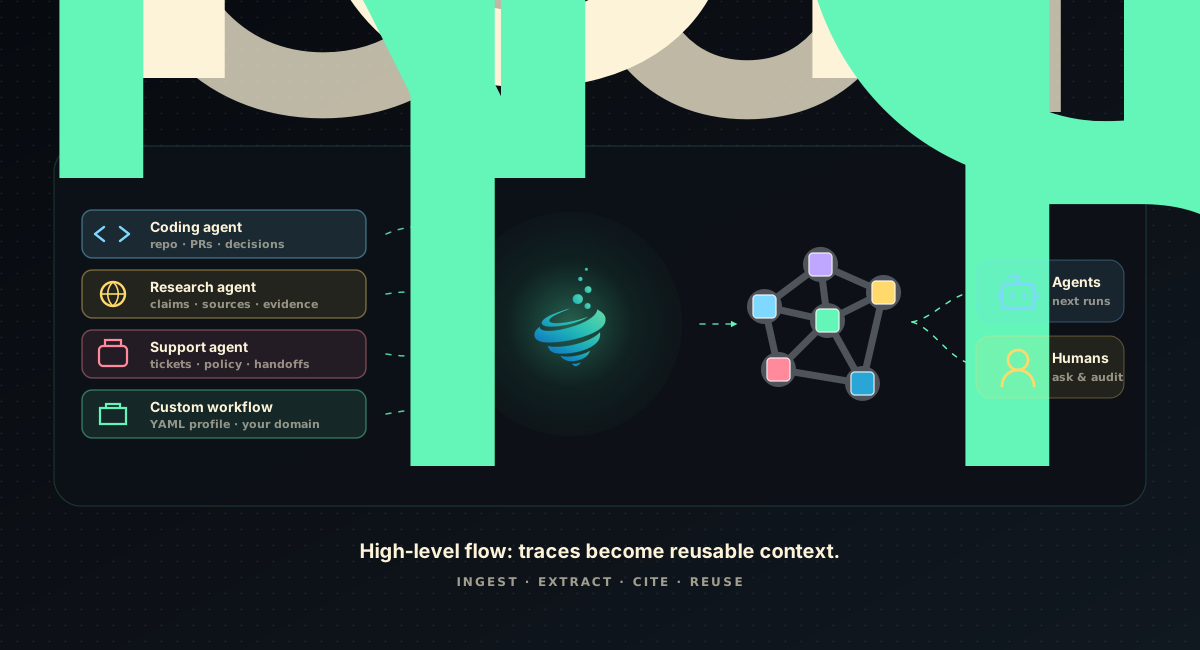
Lerim turns completed agent sessions into cited context records: decisions, constraints, facts, handoffs, and evidence future agents can retrieve before they work.
Self-host the Apache-2.0 core. Hire Lerim for agent harness engineering, prompt and context optimization, private deployment, and SFT/RL model specialization.
Why it matters
Raw traces are too long, too noisy, and too platform-specific to replay directly. Lerim compiles the small operating context future agents actually need.
Carry forward decisions, constraints, failed paths, and handoffs without replaying every transcript.
Context records stay linked to the session that produced them, so later agents can inspect why the memory exists.
Routine chatter, temporary steps, and source-derivable facts should not become permanent operating context.
Enterprise services
Teams can self-host Lerim. We sell the production work around it: harness design, prompt/context optimization, eval loops, private deployment, and SFT/RL model specialization.
Connect customer agent runs, tools, repos, tickets, chats, and business workflows into Lerim’s trace ingestion layer. Build clean adapters, redaction, scopes, and source-session capture so Lerim can compile reliable context.
Tune Lerim’s compiler for the customer’s domain: what becomes memory, what gets rejected, how records are merged, cited, retrieved, and injected into future agent runs.
Deploy Lerim as the customer’s private context layer: MCP server, context database, eval workflows, audit logs, retention, monitoring, SSO/RBAC, and production support.
Train private models inside the Lerim harness using approved traces, context records, corrections, and evals so repeated workflows run cheaper, faster, and with customer-specific context.
First paid step
Pick one repeated AI-agent workflow. We inspect the current harness, trace quality, prompts, context flow, and evals, then deliver a concrete optimization and training roadmap.
Where it fits
The best first deployment is a repeated, evidence-heavy workflow where agents rediscover decisions, constraints, or handoffs between runs.
Source trails, evidence strength, assumptions, rejected leads, brief constraints, and analyst handoffs.
Customer constraints, failed fixes, product behavior, escalation reasons, policy references, and next steps.
Investigation timelines, owner decisions, policy exceptions, remediation evidence, runbook lessons, and unresolved risks.
Repo conventions, architecture decisions, failed tests, release lessons, and implementation handoffs.
How it works
Lerim is not a broad manual memory bucket. Completed sessions become compact, cited context only after the compiler decides the signal is reusable.
Read native coding-agent histories or import clean custom traces from business workflows.
Extract reusable decisions, constraints, facts, preferences, handoffs, and evidence while rejecting weak signal.
Serve context into the agent harness through CLI answers, startup briefs, MCP tools, and hosted or private deployment surfaces.
Integration shape
Native adapters are best when an agent has a stable local session store. MCP gives compatible clients recall and completed-session submission without pretending every client has native capture.
Local CLI/runtime, SQLite context store, BAML/LangGraph extraction, native coding-agent adapters, generic trace import, MCP server, context briefs, and cited answers.
Agent harness engineering, prompt/context optimization, private MCP, SSO/RBAC, audit logs, retention, and specialized SFT/RL training sit above the Apache-2.0 core.
What a pilot proves
A serious rollout should prove the actual workflow: does Lerim find useful evidence, reduce repeated context work, and avoid filling memory with noise?
Measure whether future agents retrieve the session that contains the decision, constraint, or evidence they need.
Track how much transcript text is avoided while preserving the source evidence needed for the next run.
Review false positives, duplicates, vague notes, and source-derivable facts before scaling the workflow.
Start here
We will connect the traces, tune the compiler, and prove whether Lerim gives future agents better startup context than raw transcripts or manual notes.